Industrial Next Develops AI Powered Robots That Can Change Factory Tasks Within Minutes
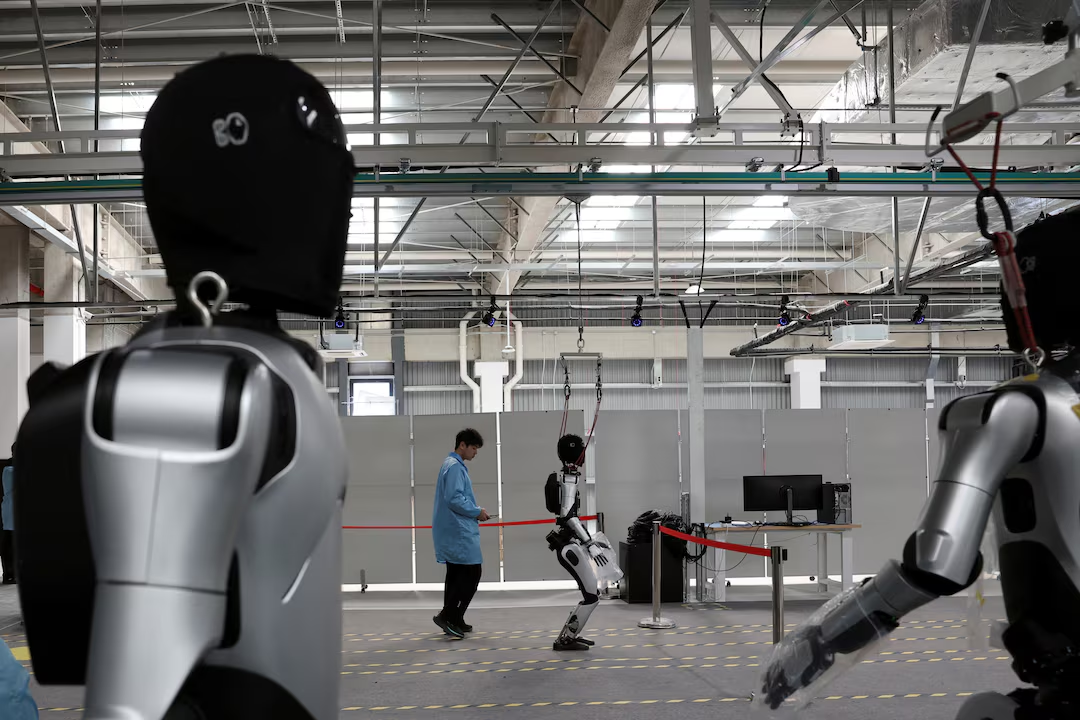
Industrial Next, a San Francisco based robotics startup, is developing artificial intelligence powered robotic systems designed to help factories change production tasks within minutes instead of weeks or months.
Traditional industrial robots are generally programmed to perform specific, repetitive tasks, meaning that changing products or production processes can require extensive reprogramming, physical adjustments and equipment replacement.
Industrial Next believes its technology could make manufacturing more flexible by allowing robots to adapt to different tasks without relying on conventional programming methods.
The company presented its technology at TechCrunch Disrupt 2026 and announced a partnership with BMW Group Technology Office to evaluate its AI powered dexterous manipulation systems for manufacturing.
Founded in 2021 by former Tesla employees Lukas Pankau and Allen Pan, Industrial Next develops self contained robotic stations powered by specialised AI models that connect visual information, task understanding and physical movement.
The systems are designed to automate complex manufacturing activities that have traditionally required human workers.
Pankau and Pan developed the idea after witnessing the limitations of factory equipment while working at Tesla.
Despite advances in vehicle design and autonomous driving technology, they found that many manufacturing processes still depended on older machines that were difficult to programme and adapt.
They believed modern artificial intelligence could help bridge the gap between advanced engineering and factory automation by enabling robots to handle a wider variety of tasks with greater flexibility.
One of the main challenges in developing adaptable robots is the shortage of training data for complex physical activities.
Unlike language models, which can learn from enormous collections of online text, robotics systems require detailed information about movement, physical contact and real world environments.
Industrial Next addresses this challenge by training its robots in highly detailed simulated environments designed to reproduce real world physics.
The company says this approach helps robots learn delicate and precise tasks without requiring every movement to be manually programmed.
Industrial Next said some of its robotic stations are already being used to manufacture a widely used smartphone, although the company did not identify the customer.
The systems reportedly perform delicate tasks such as threading flexible cables, attaching small connector caps and removing protective film from camera modules and buttons.
The company aims to expand its technology to more complex manufacturing operations, including vehicle assembly.
Its long term ambition is to develop systems capable of building an entire car without direct human intervention, potentially transforming factory operations and reducing the time required to introduce new products.
Source: TechCrunch

news via inbox
Get the latest updates delivered straight to your inbox. Subscribe now!