
Humanoid Robotics Firm Agility For Public Listing, CEO Says Home Robots Years Away
The race to dominate the humanoid robotics industry is gathering momentum as companies continue to attract billions of dollars in investments from venture capitalists and technology investors.
Despite the surge in funding across the sector, Agility Robotics has chosen a different path by announcing plans to become the first dedicated humanoid robotics company to trade on the public stock market.
The Oregon based company intends to go public through a merger with Churchill Capital Corp XI, a Special Purpose Acquisition Company.
The proposed transaction places Agility Robotics at an estimated value of about $2.5 billion and is expected to generate more than $620 million in fresh capital, subject to regulatory approvals and shareholder consent later this year.
Speaking shortly after the announcement, Agility Robotics Chief Executive Officer Peggy Johnson maintained a cautious outlook despite the growing excitement surrounding artificial intelligence and robotics.
Rather than making ambitious promises about the future, Johnson stressed that the company’s immediate priority remains expanding its commercial operations and delivering on existing customer commitments.
She noted that the additional funding would strengthen production capacity at the company’s manufacturing facility in Salem, Oregon, allowing it to meet increasing demand from businesses seeking automated solutions for warehouses and industrial environments.
Founded in 2015 as a spin off from Oregon State University, Agility Robotics has focused on developing humanoid robots capable of carrying out physically demanding tasks in workplaces designed for humans.
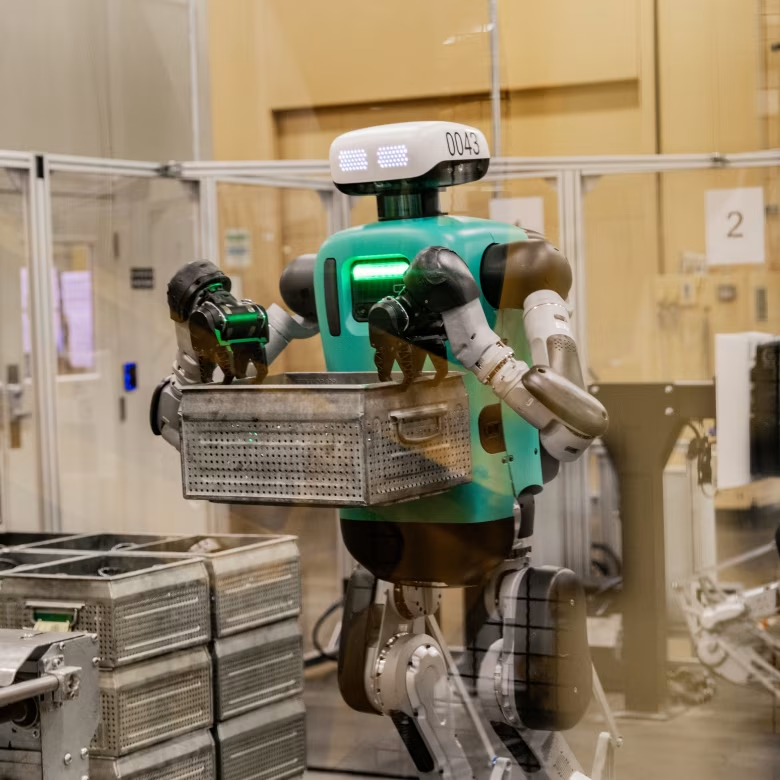
Its flagship robot, Digit, stands approximately five feet nine inches tall and weighs about 160 pounds. Designed primarily for warehouse operations, the robot is capable of lifting and transporting heavy containers while navigating spaces built for human workers.
One of its most distinctive engineering features is its uniquely designed reverse bending legs, which enable it to retrieve items from floor level and higher storage shelves with greater flexibility than conventional robotic systems.
Johnson explained that Agility Robotics combines advanced language models with years of practical robotics experience to improve the robot’s performance.
While artificial intelligence systems assist Digit in understanding instructions and making decisions, she said the company’s greatest strength lies in the physical intelligence developed from years of operating robots in real industrial environments.
According to her, the extensive amount of operational data gathered from customer deployments gives Agility a significant advantage over competitors that have largely demonstrated their robots in controlled laboratory settings.
She also emphasized that safety remains central to the company’s design philosophy, noting that industrial robots must satisfy rigorous certification standards before being introduced into customer facilities.
Although public interest in household robots continues to grow, Johnson believes widespread adoption in homes is still more than a decade away.
She explained that homes present far greater challenges than warehouses because they contain unpredictable obstacles such as children, pets, visitors and constantly changing surroundings.
For now, Agility Robotics will remain focused on supplying businesses facing severe labour shortages in manufacturing and logistics.
With millions of physically demanding jobs remaining vacant across the United States, the company believes industrial automation offers the greatest opportunity for growth while the dream of having humanoid robots in everyday homes continues to evolve.
Source: TechCrunch

news via inbox
Get the latest updates delivered straight to your inbox. Subscribe now!