
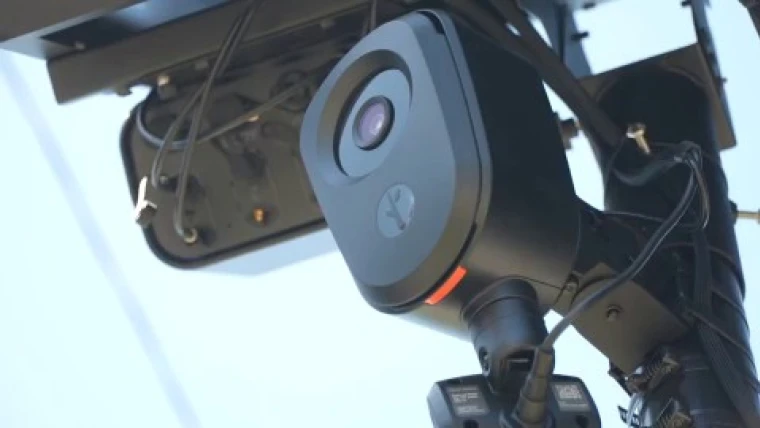
Flock Introduces New Measures to Curb Police Misuse of License Plate Surveillance
Surveillance technology company Flock has announced new policies and tools aimed at preventing law enforcement agencies from misusing its automated license plate reader systems and strengthening accountability among its customers.
Among the changes announced Thursday is a recommendation that police departments retain surveillance data for just seven days, down from the previous 30-day period. Flock has also introduced a feature called “Evidence Mode,” which allows customers to preserve data for longer periods in exceptional circumstances. Activating the feature requires users to provide a specific case number.
The company is also giving law enforcement agencies greater control over how they share surveillance data with other Flock customers.
Departments will be able to establish restrictions based on the type of offense being investigated. One of the most significant tools highlighted by Flock is “Audit Assistance,” a feature introduced in April to help identify potentially suspicious activity by users of its surveillance systems.
Flock said more than one-third of its customers have activated the feature since its launch and announced that all customers will be required to enable it by the end of the year.
According to Flock, Audit Assistance is designed to detect unusual activity and alert administrators for further review. In some cases, the system can automatically restrict a user’s access until an administrator investigates the flagged activity.
Flock executives have repeatedly promoted the tool as an important safeguard against misuse. However, the company has provided limited information about precisely how the system identifies suspicious behavior.
Flock’s Head of Trust and Compliance, Ashley Haber, has said the tool can identify search histories that appear unusual for a particular user.
Flock co-founder Paige Todd has similarly described the system as being capable of identifying unusual patterns at an early stage, including repeated searches for the same license plate over an extended period.
Major Patrick Krieg of the Dunwoody Police Department in Georgia, which uses Flock technology, described Audit Assistance as an algorithm capable of alerting the department to potential bias.
Despite these descriptions, several important questions about the technology remain unanswered. Flock has not provided detailed information about the methodology behind the tool, the data used to develop it or the specific criteria that determine whether activity is considered abnormal.
The company has also clarified that Audit Assistance does not rely on artificial intelligence or machine learning. Instead, Flock describes it as a data-analysis tool designed to identify unusual search patterns that may warrant additional investigation.
For example, Flock said a user searching for the same license plate under multiple case numbers could trigger an alert because the behavior might indicate improper use of the system. However, the company emphasized that an alert does not automatically mean misconduct has occurred; rather, it signals that the activity should be reviewed.
Questions nevertheless remain about the tool’s effectiveness. Flock has not disclosed statistics showing how often Audit Assistance successfully identifies abuse, nor has it provided information about false-positive or false-negative rates. It is also unclear whether the system has undergone independent third-party testing.
Privacy advocates and critics of Flock have expressed skepticism about the company’s claims. Chad Marlow, senior policy counsel at the American Civil Liberties Union, argued that there is currently insufficient evidence to demonstrate that Audit Assistance consistently prevents or detects misuse.
He noted that while several law enforcement officers have been arrested, dismissed or disciplined for allegedly abusing Flock systems, those cases alone do not establish how effective the auditing tool is. Marlow said independent testing would be necessary to determine whether the system catches a large majority of abusive activity or only a small percentage of violations.
Without such an assessment, he argued, it remains difficult to determine whether Audit Assistance represents a meaningful security measure or simply provides the appearance of oversight.
Cooper Quintin, a security researcher and senior public interest technologist at the Electronic Frontier Foundation, raised another concern: even an effective auditing system could potentially be circumvented by people determined to misuse the technology.
Quintin argued that accountability ultimately depends on whether individuals who abuse surveillance systems face meaningful consequences.
He also suggested that legal restrictions and requirements for warrants could provide stronger safeguards than relying solely on internal auditing tools operated by the same law enforcement agencies using the technology.
Rachel Levinson-Waldman, director of the Brennan Center’s Liberty and National Security Program, said requiring all Flock customers to activate Audit Assistance represents a positive development. However, she also stressed that the tool itself should undergo independent auditing because there is still insufficient information about how effectively it works in real-world situations.
Flock’s latest announcement comes amid growing scrutiny of its surveillance technology and reports of law enforcement officers allegedly using its systems for improper purposes. Earlier this week, three former Georgia sheriff’s deputies were arrested over allegations that they used Flock cameras to monitor individuals with whom they had personal relationships.
The Bibb County Sheriff’s Office said the alleged misuse was uncovered with the help of Flock’s Audit Assistance system. The case has provided Flock with a prominent example of its new tool identifying potential abuse. However, critics maintain that isolated cases are not enough to demonstrate the system’s overall effectiveness.
As Flock expands its network of automated license plate readers, questions about transparency, oversight and accountability are likely to remain central to the debate surrounding the technology. While the company says its latest measures are designed to prevent misuse, privacy advocates argue that stronger independent oversight and legal safeguards may be necessary to ensure that surveillance systems are not abused.
Source: TechCrunch

news via inbox
Get the latest updates delivered straight to your inbox. Subscribe now!